Key Takeaways:
- Post-deployment drinking escalation is a documented clinical pattern—not a character flaw or a phase—rooted in the stress of combat exposure, reintegration difficulty, and military drinking culture that normalizes heavy use.
- Alcohol use disorder follows specific, identifiable criteria. Military spouses can use DSM-5 benchmarks to distinguish situationally heavy drinking from a substance use problem that responds to treatment.
- TRICARE covers substance use treatment for active-duty service members and, in many cases, their dependents—meaning cost and insurance are not necessarily barriers to getting help.
- Royal Life Centers at Cascade Heights provides a full continuum of care near Fairchild Air Force Base, including medical detox, residential treatment, and outpatient programs, with confidential admissions and insurance verification available.
Question:
How do I help my military spouse with a drinking problem after deployment?
Answer:
Post-deployment drinking escalation is one of the most consistent and least-discussed patterns affecting military families. When a service member returns from deployment and begins drinking more—earlier, more frequently, or in ways that feel disconnected from the person you knew—that change is not arbitrary. It reflects how the brain responds to prolonged combat stress, how reintegration strains even strong relationships, and how military culture has long normalized heavy drinking as a coping mechanism. Military spouses who recognize this pattern often carry their concern quietly, unsure whether to name it or uncertain how to bring it up without damage. This post names what they are seeing, explains the documented clinical pattern behind it, and provides clear guidance on recognizing alcohol use disorder, having the conversation, and accessing treatment. Royal Life Centers at Cascade Heights serves military families near Fairchild Air Force Base with confidential, TRICARE-accepted care across a full continuum of treatment options.
The homecoming you pictured probably looked different from this.
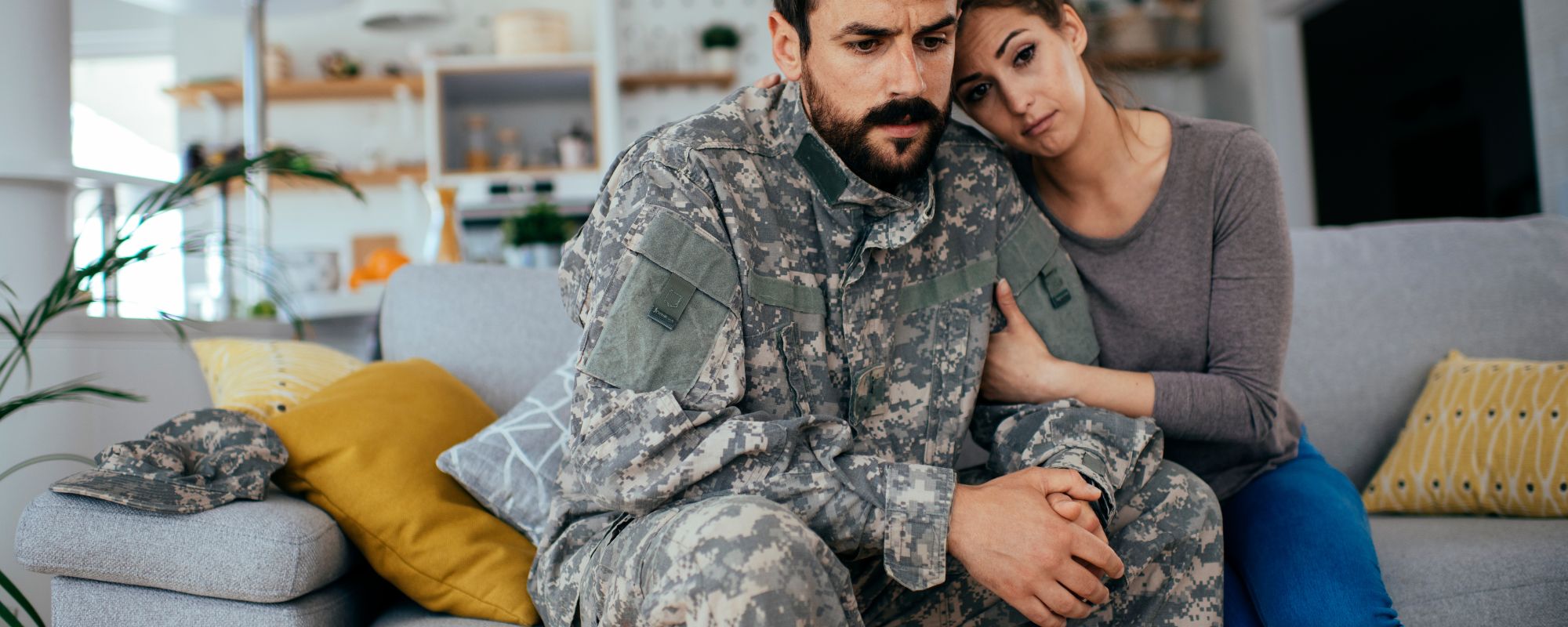
You imagined relief. Maybe a long exhale, the feeling of your family being whole again. Instead, there is a version of your spouse standing in front of you who looks familiar but feels like someone you are still learning to read. And one of the things you keep noticing—quietly, guiltily, without wanting to name it—is how much they are drinking.
You are not making it up. You are not overreacting. What you are seeing has a name, and it fits a pattern that researchers, clinicians, and military family advocates have documented consistently across deployments and generations of service.
This post is for you, the spouse who is still deciding what you are looking at. It will help you name what you are seeing, understand why deployment changes drinking patterns, recognize the line between heavier use and a substance use problem, and learn how to take a next step—for your partner, and for yourself.
What Are the Behavioral Changes Military Spouses Notice After Deployment?
Before you can have a conversation with your partner, or with anyone else, it helps to get specific. Vague worry is hard to act on. Concrete observations are not.
Military spouses who have watched a partner’s drinking increase after deployment often describe a similar cluster of changes:
- Drinking earlier in the day, often before what used to be an understood threshold—before dinner, before the kids are in bed, before the weekend
- Drinking alone, or becoming irritable when drinking is paused or mentioned
- Drinking to fall asleep, and sleeping poorly anyway
- Increased tolerance, where the amount that used to produce visible effects no longer does
- Mood changes tied to alcohol availability—tension before drinking, a brief window of ease during, and withdrawal or irritability after
- Minimizing or joking it off when you bring it up
- Social withdrawal, sometimes paired with an increase in drinking at home
None of these changes, on their own, constitute a clinical diagnosis. But together, and especially in the months following a deployment, they are worth paying attention to.
If you are already asking whether what your spouse is doing crosses a line, that question deserves a real answer—not reassurance designed to make you feel better right now.
Why Does Deployment Change Drinking Patterns? Understanding Post-Deployment Substance Escalation
Post-deployment drinking escalation is not random. It follows a well-documented pattern rooted in what the body and brain do under prolonged stress—and what happens when that stress is suddenly removed.
According to research published by the RAND Corporation and the Substance Abuse and Mental Health Services Administration (SAMHSA), heavy drinking rates among active-duty military personnel are significantly higher than in the general population. Combat exposure, in particular, is associated with increased alcohol use after return—not during deployment, when access is often restricted, but in the weeks and months that follow.
There are several reasons this happens:
The nervous system doesn’t reset on a timeline. A service member returning from deployment has spent months in a state of sustained vigilance. Sleep is disrupted. Threat-detection is heightened. Alcohol, for many, becomes a tool to turn the volume down—to get through a crowded store, to sleep through the night, to stop replaying what they saw.
Reintegration is genuinely hard. Coming home means re-entering relationships, routines, and roles that changed while they were gone. You changed. The kids changed. The dynamic shifted. That gap—between who left and what they’re returning to—can feel disorienting in ways that are difficult to talk about.
PTSD and alcohol use disorder frequently co-occur. The VA has consistently found that veterans meeting criteria for PTSD also show elevated rates of alcohol use disorder. These conditions reinforce each other: trauma symptoms increase drinking, and drinking disrupts the emotional processing needed to address trauma.
None of this means your spouse is weak or broken. It means they are in pain, and they found something that temporarily reduces it.
Military Drinking Culture and Why It Escalates After Combat
Understanding military drinking culture matters here, because it shapes how your spouse thinks about their own use—and why they may not see a problem where you clearly do.
Heavy drinking in many military communities is normalized. It is woven into bonding rituals, post-deployment traditions, and the unspoken code that governs how service members process hard things. Seeking help, by contrast, has historically carried a stigma that drinking does not.
This means your spouse may genuinely believe their drinking is proportionate, expected, or earned. They may compare themselves to peers who drink similarly. They may not be lying when they say it isn’t a problem—they may be measuring by a baseline that was already elevated long before you started noticing.
This context does not excuse harmful behavior. It does help explain why the conversation you need to have will require more than pointing at the evidence.
What Signs Distinguish Heavier Drinking from a Substance Use Problem?
This is the question most spouses are actually trying to answer. There is no single bright line, but clinicians use a set of criteria—drawn from the DSM-5—to distinguish alcohol use disorder from situationally heavy drinking.
Signs that what you are seeing may be more than a temporary pattern include:
- Drinking more than intended, or for longer than intended, consistently
- Unsuccessful attempts to cut back
- Spending significant time obtaining, using, or recovering from alcohol
- Cravings or strong urges to drink
- Drinking continuing despite visible harm to relationships, health, or responsibilities
- Needing more alcohol to achieve the same effect (tolerance)
- Symptoms of withdrawal—sweating, shakiness, irritability, nausea—when not drinking
Two or three of these criteria indicate mild alcohol use disorder. Four or five indicate moderate. Six or more indicate severe.
If several of these sound familiar, what you are seeing likely has a clinical name—and that means it responds to clinical treatment.
How Can You Bring Up a Spouse’s Drinking Without Damaging Your Marriage?
Bringing up a partner’s drinking is one of the hardest conversations in a marriage, and the fear of blowing it up often keeps spouses silent longer than is helpful.
A few principles that tend to hold:
Start with observation, not accusation. “I’ve noticed you’ve been having a drink before dinner most nights, and I’ve been worried about you” lands differently than “you’ve been drinking too much.” The first invites a response. The second triggers defense.
Choose the right moment. Not when they are drinking, not when you are angry, and not in front of others. Aim for a calm window, when both of you are rested and not mid-conflict.
Name what you are feeling, not what they are doing wrong. Statements built around your experience—concern, fear, loneliness—are harder to argue with than statements built around their behavior.
Don’t expect one conversation to resolve it. Awareness that there is a problem usually develops slowly, especially when military culture has normalized the behavior. Your goal in a first conversation may simply be to open a door, not walk through it together.
Get support for yourself, regardless of where they are. Al-Anon exists for this reason. So do licensed therapists who specialize in military families. You do not have to wait for your spouse to decide to get help before you decide to get support.
What Does Supporting a Partner in Recovery Actually Look Like?
If your spouse does enter treatment—whether through an outpatient program, residential care, or another level of support—your role matters more than many people expect.
Supporting a partner in recovery is not the same as managing their recovery. The distinction is important. Your job is not to monitor, track, or enforce. It is to be present, to maintain honest communication, and to hold reasonable boundaries without punishing the process.
In practice, this often looks like:
- Attending family therapy sessions when offered
- Learning about the recovery process so you understand what your spouse is experiencing
- Identifying and removing your own enabling behaviors—covering for them, minimizing to others, absorbing consequences that should be theirs
- Maintaining your own life, relationships, and support systems
- Being honest when things are hard without using sobriety as a bargaining chip
Recovery is not linear. Relapse is common and does not erase progress. Families who understand this tend to fare better than those who treat any setback as a failure.